Shipping Container Solutions in Bristol
Partner with Shipping Containers of Bristol and experience the difference:

Simply choose the size and condition of the storage container you need.
We'll deliver it within 5-7 business days.
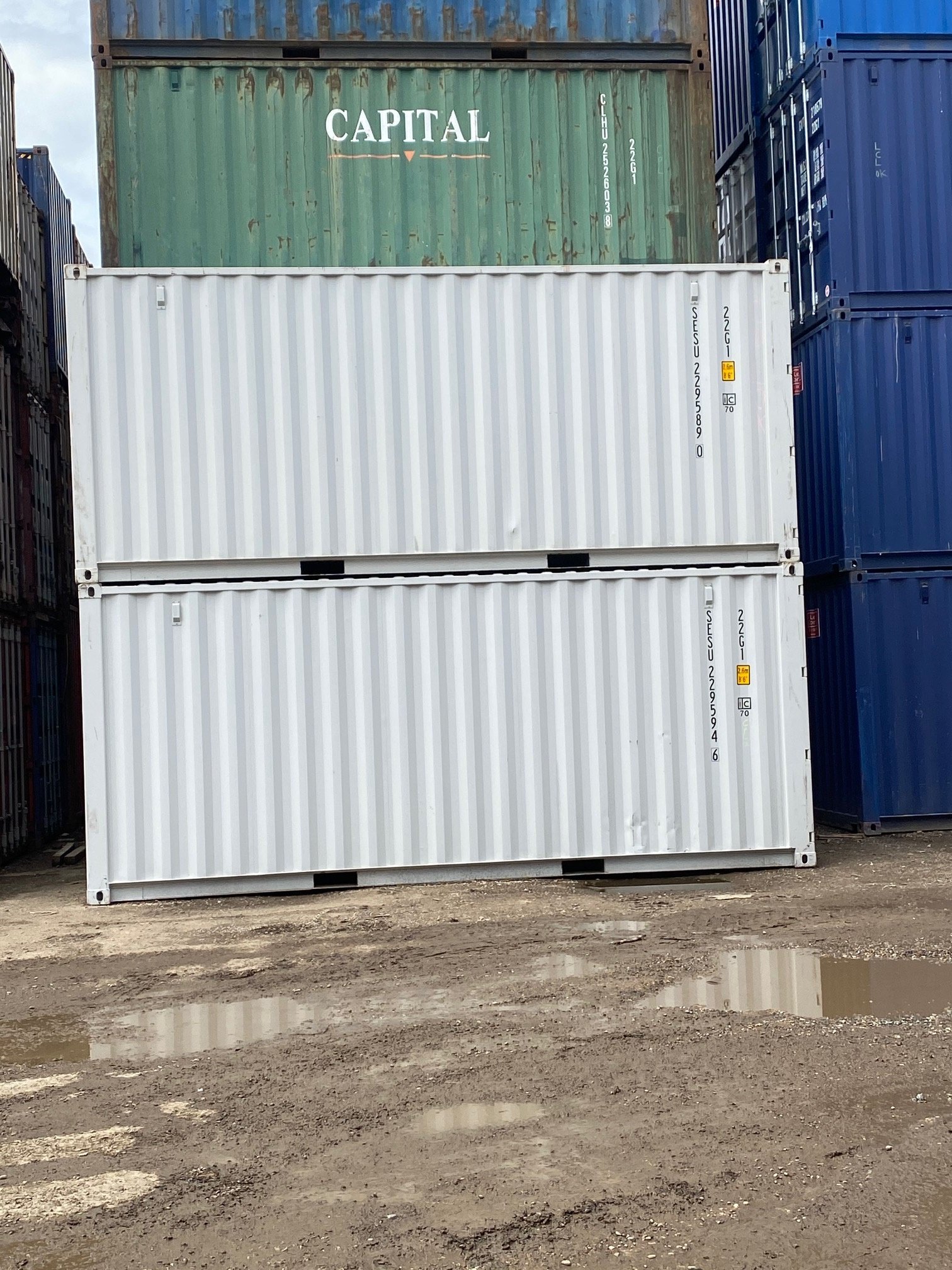
You can buy shipping containers in various sizes, including 10ft, 20ft, and 40ft. Specialised types such as refrigerated containers, full-side access containers, high cubes, and open tops are also available.
A one-trip shipping container has only been used once to transport cargo from the manufacturer to its destination, making it nearly new with minimal wear and tear.
Delivery usually takes 4 to 7 days.
Generally, shipping containers are considered temporary structures and do not require planning permission. However, checking with your local planning office is advisable.
A high cube container is 9ft 6in tall, one ft taller than standard containers, providing extra height for storing taller items or when more volume is needed.
Your container will have a fitted lockbox. You can enhance its security by purchasing high-security locks and security lighting.
Yes, shipping containers are designed to be stackable, often up to several layers high.
Shipping containers are durable, secure, weatherproof, and easily moved and modified to meet specific needs.
Ensure the ground is level, solid, and well-drained. Clear any obstacles and verify enough space for the delivery vehicle to access and place the container.
Shipping containers are built to ISO standards and commonly used for international shipping.
Shipping containers are commonly transported by rail as they fit standard rail specifications.
Yes, you can buy multiple containers.
Regular maintenance, such as rust prevention, proper drainage, and repainting, can help extend the lifespan of a shipping container.
You can hire shipping containers in various sizes, including 10ft, 20ft, and 40ft. Special container types include refrigerated containers, full-side access containers, high-cube containers, and open-top containers.
Hiring a shipping container offers flexibility, lower upfront costs, no maintenance responsibilities, and the ability to use the container for as long as needed without a long-term commitment.
The main disadvantages include ongoing rental costs, limited customisation options, and dependence on us for maintenance and availability.
Minimum hire periods typically range from eight to twelve weeks, depending on the provider.
We can sometimes offer you a choice between Bottle Green and Gentian Blue for new containers. However, specific colours aren't guaranteed for used containers due to their depot storage order.
Submit a quote inquiry form or email the leasing company. Once you agree on the quote, the company will guide you through the straightforward hiring process.
Yes, short-term hires are available and are ideal for events, temporary storage, or during renovations.
Hired containers are usually in good, functional condition. They may show signs of wear but will be watertight and structurally sound.
Please notify us so we can arrange for the collection.
Contact us to discuss extending the hire period. We offer flexible rental agreements.
Yes, new containers typically cost more to hire than used ones. Used containers may have signs of wear, but are generally more cost-effective.
You can hire multiple containers, and some companies offer stacking options to maximise space.
Yes, but you may still be charged for the minimum hire period. Any unused prepaid rent beyond the minimum period will typically be refunded.
Container delivery with a crane involves using a vehicle to deliver and place shipping containers. These vehicles have a crane arm, allowing them to lift and manoeuvre containers into position.
The reach of a truck with a crane varies depending on the size and weight of the container, as well as the specific truck's crane capacity. Generally, bigger trucks have better reach, but it's best to inform the haulier of your specific needs for an accurate assessment.
Trucks equipped with cranes can lift containers over obstacles, such as fences or walls, provided the height and depth are within the crane's reach. It's essential to inform the haulier about such obstacles to ensure the correct vehicle is used.
Trucks require a stable, hard-standing surface, such as tarmac or concrete, to operate safely. They cannot deliver on soft surfaces, such as mud, soft earth, or grass, because they risk getting stuck and damaging the vehicle.
Trucks cannot deliver containers onto grass because the vehicle could get stuck. They must remain on hard-standing surfaces at all times.
Ensure the delivery site has suitable access, clear and stable ground, and no overhead obstructions. Preparing supports for the container, such as paving slabs or concrete pads, is also recommended to prevent sinking and ensure level placement.
Trucks vary in size, but articulated trucks used for 40ft containers are around 65ft long. Smaller rigid vehicles are typically around 40ft long. The exact size depends on the container and site access requirements.
Trucks can deliver containers into buildings if there is adequate overhead clearance for the crane to operate. The entrance must be large enough for the truck to enter, and there must be space for the crane's stabilisers.
Delivery vehicles can weigh over 25 tonnes for rigid trucks and over 35 tonnes for articulated trucks. Ensure your site and access roads handle this weight to avoid damage and failed deliveries.
Trucks require sufficient space for the vehicle, the container, and the crane's stabilisers, which extend outward. Typically, an 8ft wide vehicle requires an additional 5ft on each side for the stabilisers.
Low bridges and overhanging branches can obstruct delivery. Inform the haulier about such obstacles so they can plan the route and possibly use a different vehicle or crane setup.
No, crane-equipped trucks are not long enough to lift containers over houses. Alternative methods like booking a separate crane may be necessary for such deliveries.
Please provide detailed information, photos, or videos for tight delivery sites. This helps us assess the situation and determine if delivery is feasible. A site survey may also be recommended.
Difficult deliveries may incur additional costs, such as site surveys, special equipment, or extra on-site time. It's best to discuss any potential challenges with us in advance.
Trucks can transport multiple containers, depending on the vehicle and site accessibility. Certain vehicles can convey two 20ft containers in a single trip.
Please inform us about any overhead power lines requiring significant clearance. Some hauliers may refuse to lift within 20 meters of live power cables due to safety concerns.
We offer new and used 20ft shipping containers at Shipping Containers of Bristol. New containers are ideal for those requiring a pristine unit. In contrast, used containers offer a cost-effective solution without compromising on quality.
A high cube 20ft container is taller than the standard container, with a height of 9ft 6in (2.90m) compared to the standard 8ft 6in (2.59m), providing additional internal space.
The tare weight of a 20ft shipping container is around 2,185 kg (4,818 lbs), but this can vary slightly depending on the specific design and manufacturer.
Properly maintained, a 20ft shipping container can last up to 25 years, especially if made from high-quality materials like Corten steel.
Yes, 20ft shipping containers are designed to be watertight and weather-resistant, making them suitable for storing goods in various environments.
20ft containers meet ISO standards. They can be used for international shipping with a valid CSC plate.
The floor of a 20ft shipping container is typically made from 27mm marine-grade plywood, which is durable and moisture-resistant.
Benefits include durability, security, portability, and the ability to be customised for specific storage needs, making them ideal for various industries.
Common modifications include adding doors, windows, insulation, electrical systems, ventilation, and shelving to suit various uses.
A 40ft shipping container can last up to 25 years if properly maintained.
Typical uses include storage, transport, and conversion into offices, pop-up shops, studios, and even homes.
They can be modified with features like doors, windows, insulation, and other customisations to fit specific needs.
A high-cube 40ft container is a shipping container that is 9ft 6in tall, providing an extra 6 inches of height compared to standard 40ft containers.
Indeed, 40ft shipping containers are constructed to be watertight and weather-resistant, rendering them suitable for storing goods in diverse environmental conditions.
Yes, 40ft containers meet ISO standards and can be used for international shipping, provided they have a valid CSC plate.
The floor of a 40ft shipping container is typically made from 27mm marine-grade plywood, which is durable and moisture-resistant.
Adding lockboxes, high-security locks, and security lighting can help secure a 40ft container.
Many 40ft containers are repurposed into residential homes due to their durability and spaciousness.
Yes, 40ft containers are commonly transported by rail, as they fit standard rail specifications.
20ft open-top containers are utilised for transporting oversized goods that require top loading and unloading, such as machinery, bulk materials like timber or scrap metal, and fragile or awkwardly shaped items.
The external dimensions of a 20ft open-top container are typically 20’ long, 8’ wide, and 8’6” high. The internal dimensions are around 19’4” long, 7’8” wide and 7’9” high.
The maximum gross weight of a 20ft open-top container is usually around 30,480 kg (67,200 lbs).
20ft open-top containers are constructed from Corten steel and feature a removable tarpaulin roof, roof bows, and a 28mm wooden floor supported by steel cross-members. They also include forklift pockets and two locking bars on each door.
Open-top containers are suitable for international shipping. They are CSC-plated and meet the necessary standards for international transport.
Open-top containers can be stacked just like standard containers, allowing for efficient use of space in shipping yards and transport vessels.
The height of the cargo must not exceed the height of the container’s sides when the tarpaulin is in place, ensuring it can be securely covered for transport.
Open-top containers are not usually refrigerated. Refrigerated containers, also known as reefers, are recommended for goods that require specific temperatures.
Ideal cargo for open-top containers includes heavy machinery, construction materials, bulk commodities such as grain or coal, and large equipment that cannot fit through standard container doors.
Open-top containers are usually loaded and unloaded using cranes or other overhead lifting equipment, which can easily access the open top.
40ft open-top containers serve similar purposes as 20-foot ones, but they can accommodate larger volumes of oversized goods, such as construction materials, heavy machinery, and large equipment.
The outer measurements of a 40-foot open-top container usually are 40 feet in length, 8 feet in width, and 8 feet 6 inches in height. The inner dimensions are approximately 39 feet 5 inches long, 7 feet 8 inches wide, and 7 feet 10 inches high.
The 40ft open-top containers are constructed from durable Corten steel and come equipped with a removable tarpaulin roof and removable roof bows. These containers feature a sturdy 28mm wooden floor supported by steel cross members. Additionally, they are designed with exterior hinged double doors and two locking bars on each door for added security.
Indeed, 40ft open-top containers are suitable for international shipping as they are CSC-plated and compliant with the required standards for international transportation.
Open-top containers, measuring 40 feet in length, can be stacked like standard containers, enabling efficient use of space in shipping yards and on transport vessels.
When the tarpaulin is in place, the height of the cargo should not exceed the height of the container’s sides, ensuring it can be securely covered for transport.
In general, 40ft Open-top containers are not equipped for refrigeration. For goods that require specific temperature conditions, it is advisable to utilise refrigerated containers, commonly known as reefers.
The tare weight of a 40ft open-top container is typically around 4,050 kg (8,926 lbs).
40ft open-top containers are commonly loaded and unloaded using cranes or other overhead lifting equipment, easily manoeuvred to access the open top.
The dimensions of a standard 20ft refrigerated container are typically 20ft long, 8ft in width, and 8.5ft in height. Its internal dimensions provide approximately 19.4ft of length, 7.8ft of width, and 7.9ft of height. A standard 40ft refrigerated container measures 40ft in length, 8ft in width, and 9.5ft in height. Its internal dimensions offer approximately 39.4ft of length, 7.8ft of width, and 8.9ft of height.
Refrigerated containers, also known as reefers, can maintain temperatures from -30°C to +30°C, ensuring the preservation of perishable goods.
Refrigerated containers are ideal for storing perishable items, including meat, fruits, vegetables, dairy products, pharmaceuticals, and frozen foods.
Refrigerated containers typically require a 3-phase electrical supply, with a 32-amp motor-rated power supply being standard.
Single-phase refrigerated containers are available, typically maintaining temperatures between +8°C and -20°C.
Refrigerated containers utilise integrated refrigeration units to maintain a specific temperature range within the interior space, regardless of external conditions.
Refrigerated containers are highly versatile and designed to store and transport temperature-sensitive goods. By maintaining specific temperature conditions, they effectively extend the shelf life of perishable goods, mitigate the risk of spoilage, and enable businesses to store larger quantities of stock securely.
Reefer containers have a T-shaped floor decking design that channels chilled air from the bottom of the unit, ensuring even cooling throughout the container.
Safety features in refrigerated containers can include door switches that stop fans when the door is opened, emergency stop buttons, and interior door release mechanisms.
Regular maintenance of a refrigerated container includes cleaning both the interior and exterior, inspecting the refrigeration unit, and ensuring that food hygiene standards are met.
The maximum gross weight of a 20ft refrigerated container is typically around 30,480 kg. The maximum gross weight of a 40ft refrigerated container is usually about 32,475 kg.
Many refrigerated containers come equipped with emergency internal lighting and alarms to handle power failures and ensure the safety of the stored goods.
High-quality insulation in refrigerated containers helps maintain the internal temperature by reducing the impact of external temperature fluctuations, thereby protecting the stored goods.
A flat rack container is a specialised shipping container with a flat bed and end frames, but no side walls or roof. It is used to transport oversized or irregularly shaped cargo.
Flat rack containers are commonly used to transport heavy machinery, vehicles, construction equipment, large pipes, and other bulky goods that do not fit into standard containers.
Fixed-end flat rack containers have permanently attached end walls. In contrast, collapsible flat rack containers have end walls that can be folded down to save space when empty.
Collapsible flat rack containers can be stacked when the end walls are folded down, making them efficient for storage and transportation when empty.
The maximum payload capacity of a 20ft flat rack container typically ranges around 31,000 kg, subject to variation based on the specific design and manufacturer. Similarly, a 40ft flat rack container generally offers a maximum payload capacity of approximately 39,000 kg. However, this figure may vary depending on the design and manufacturer.
Flat rack containers can create temporary structures such as bridges, walls, or platforms due to their strength and versatility.
Flat rack containers are designed for international transport, making them suitable for road, rail, and sea shipping.
Oversized cargo can be loaded onto a flat rack container from the sides or top and secured using lashing points and other securing mechanisms.
Flat rack containers are ideal for transporting heavy machinery due to their open design and high load capacity.
Flat rack containers are often used in construction projects to transport large equipment and materials, and they can also be repurposed as temporary platforms or bridges.
Partner with Shipping Containers of Bristol and experience the difference: